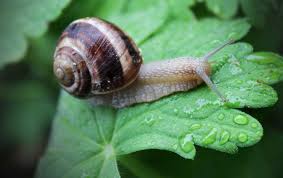
There are three main types of snails: land snails, sea snails and freshwater snails.
Snail Anatomy
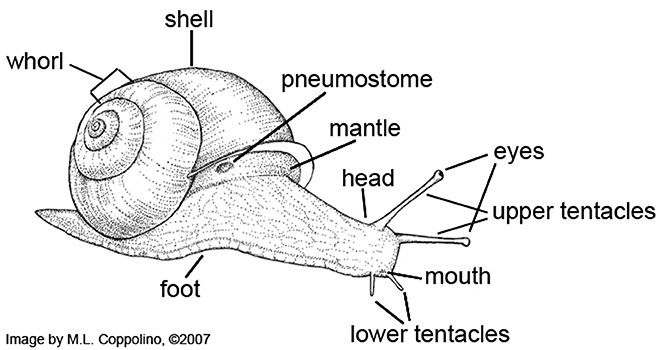
Its soft body has a heart, a lung and a stomach that are all connected by a layer of tissue. The tissue also provides room for the snail to store water.
A snail is able to breathe through its skin, and also through a breathing hole below its head.
Snails are cold-blooded.
Snails use three senses: touch, taste, and smell which is the most important.
Snails have two pairs of tentacles: the lower pair are shorter than the upper pair. The snail’s eyes are located at the tips of the upper tentacles. The snail uses the upper tentacles to smell and the lower tentacles to taste.
Snails can regrow their tentacles if they are injured.
Snails have a shell which is a part of their body. As the snail grows, the shell grows with them. If they get hurt they can heal their shell.
Snail Slime
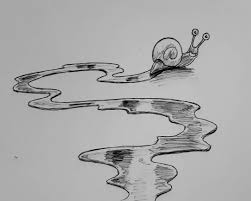
Slime is important to everything a snail does. It helps them move, defend themselves, heal and make eggs.
Nearly 1/3 of a snail’s daily energy goes into slime production.
Snails make different types of slime for different reasons. If they get injured they make a BUNCH of slime.
Eating Habits

Snails eat leaves, stems, fruits, vegetables, decaying matter, mushrooms, algae, soil and even sand.
A snail munches on its food using the radula. The radula is a ribbon-like tongue that has lots of small teeth.
Snail Speed

Snails move at a very slow speed.
Snails move using their muscular foot and pedal slime. The slime helps them move faster and safer over all types of surfaces.
The mucus trail snails leave behind is a shiny path for a couple of hours.
 Fun Snail